



Share


What is a D1 licence? Everything you need to know
If you’ve ever looked at the back of your UK driving licence and spotted the code D1, you might have wondered what this actually means, and whether it affects what you’re allowed to drive.
A D1 licence is a UK driving licence category that allows you to drive a minibus with between 9 and 16 passenger seats. If you need to transport a large group of people in a vehicle larger than a standard car or MPV, understanding the D1 category is essential.
In this guide, our experts at PSD Vehicle Rental explain exactly what a D1 licence covers, who already has one, how to get it if you don’t, and what it means for hiring a minibus in the UK.
What does the D1 licence category mean?
The D1 category is a Passenger Carrying Vehicle (PCV) entitlement on a UK driving licence. It sits between the standard category B licence (cars and vans) and the full Category D licence (buses and coaches), covering the middle ground of larger people carriers.
In practical terms, a D1 licence permits you to drive a minibus with:
- No more than 16 passenger seats (including the driver’s seat)
- A maximum vehicle length of 8 metres
- A trailer of up to 750kg maximum authorised mass (MAM)
If you also hold D1E entitlement, you can tow a trailer heavier than 750kg, as long as the combined weight of the vehicle and trailer does not exceed 12,000kg.
You can find D1 (and all your other entitlements) listed on the back of your photocard driving licence, or by checking your driving licence information online.
How D1 compares to other driving licence categories
Here’s how D1 fits into the broader licence landscape:
| Licence category | Vehicles covered | Passenger seats | Key restriction |
| Category B (standard car licence) | Cars and vans weighing up to 3,500kg | Up to 8 | Cannot drive minibuses with 9+ seats commercially |
| Category D1 | Minibuses up to 8m, weighing over 3,500kg | 9-16 (including driver’s seat) | May carry ‘nfhr’ restriction if pre-1997 entitlement |
| Category D | Any bus or coach | 17+ | Requires full PCV test, and for paid work, CPC qualification |
So, a standard Category B licence is only valid for minibuses with up to 8 passenger seats. The moment a vehicle has 9 or more passenger seats, you’re in D1 territory.
Do I already have a D1 licence?
This is one of the most misunderstood areas of UK driving licences, and the answer depends mainly on when you passed your driving test.
If you passed your test before the 1st of January 1997, you may already have D1 entitlement on your licence, but with an important restriction attached. This is often called ‘grandfather rights’, and refers to drivers who passed before the European aligned rules came into force on the date mentioned above.
However, this entitlement comes with a restriction code: 101, which stands for ‘not for hire or reward’ (nfhr). To check if you have it, look at the back of your photocard licence. If you see D1 with ‘101’ alongside it, you have the restricted version.
If you passed your test on or after the 1st of January 1997, a standard Category B licence no longer automatically grants D1 entitlement, and you’ll need to apply for and pass a separate D1 test to be permitted to drive a minibus.
There are some exceptions – for example, driving a minibus for voluntary, non-commercial purposes under specific conditions – but the default position is that you will need to qualify separately.
What is the D1 ‘not for hire or reward’ restriction?
If your D1 entitlement was granted automatically (pre-1997 licence holders), it almost certainly carries the ‘not for hire or reward’ restriction – shown as restriction code 101 on your licence.
In simple terms, this means you can drive a D1 minibus voluntarily, for social or community purposes, but you cannot accept any payment, cash or otherwise, from passengers in exchange for being carried.
In practice, this means:
- You’re allowed to drive a minibus for a school trip as a volunteer, transport a community group to an event, or take your local sports team to an away match, provided that no payment changes hands.
- You’re not allowed to charge passengers a fare, accept cash donations that go towards the vehicle costs, or drive a minibus as part of a paid job role.
To remove this restriction and drive commercially, you need to sit the full D1 test, and if driving professionally, obtain the Driver Certificate of Professional Competence (CPC). This qualification consists of a case study theory module and a practical test.
How do I get a D1 licence?
If you don’t have it already, you’ll need to qualify for your D1 licence through the formal DVLA process, which is as follows:
- Apply for a provisional D1 entitlement through the DVLA, and ensure you complete the correct application and meet the eligibility requirements.
- Meet the higher medical standards required for Passenger Carrying Vehicle (PCV) drivers. These are more stringent than for a standard car licence, particularly around eyesight and general health.
- Pass the D1 theory test. This includes a multiple-choice section and a hazard perception test – the same format as the standard driving theory test, but assessed to a higher standard.
- Complete practical training with a qualified D1 instructor. This prepares you for the manoeuvres and road driving assessed in the practical test.
- Pass the D1 practical driving test. This is conducted by the DVSA and includes vehicle safety checks, reversing manoeuvres, and an on-road drive.
If you intend to drive a minibus professionally or for payment, you will also need to complete the Initial CPC (Certificate of Professional Competence), which consists of a case study theory module and a practical demonstration test.
Do you need a D1 licence to hire a minibus?
This is the question most people want to know the answer to. And the good news is that it depends on the size of the vehicle, not just the licence in your pocket.
Vehicles like the Ford Tourneo Custom 9-seater or a 7-seater MPV such as the Skoda Kodiaq fall within the range that a standard category B licence covers, provided the vehicle’s Maximum Authorised Mass (MAM) is under 3,500kg. Most standard MPVs are well within this limit, meaning a full UK car licence is all you need.
For larger minibuses – such as a 12 or 17 seater – D1 category entitlement is typically required. So, if you’re planning to hire one of these vehicles, make sure to check the back of your driving licence before booking.
If you’re unsure, our team at PSD would be more than happy to talk you through which vehicle suits your group and what licence you need before you commit to a booking.
Hire a minibus with PSD Vehicle Rental today!
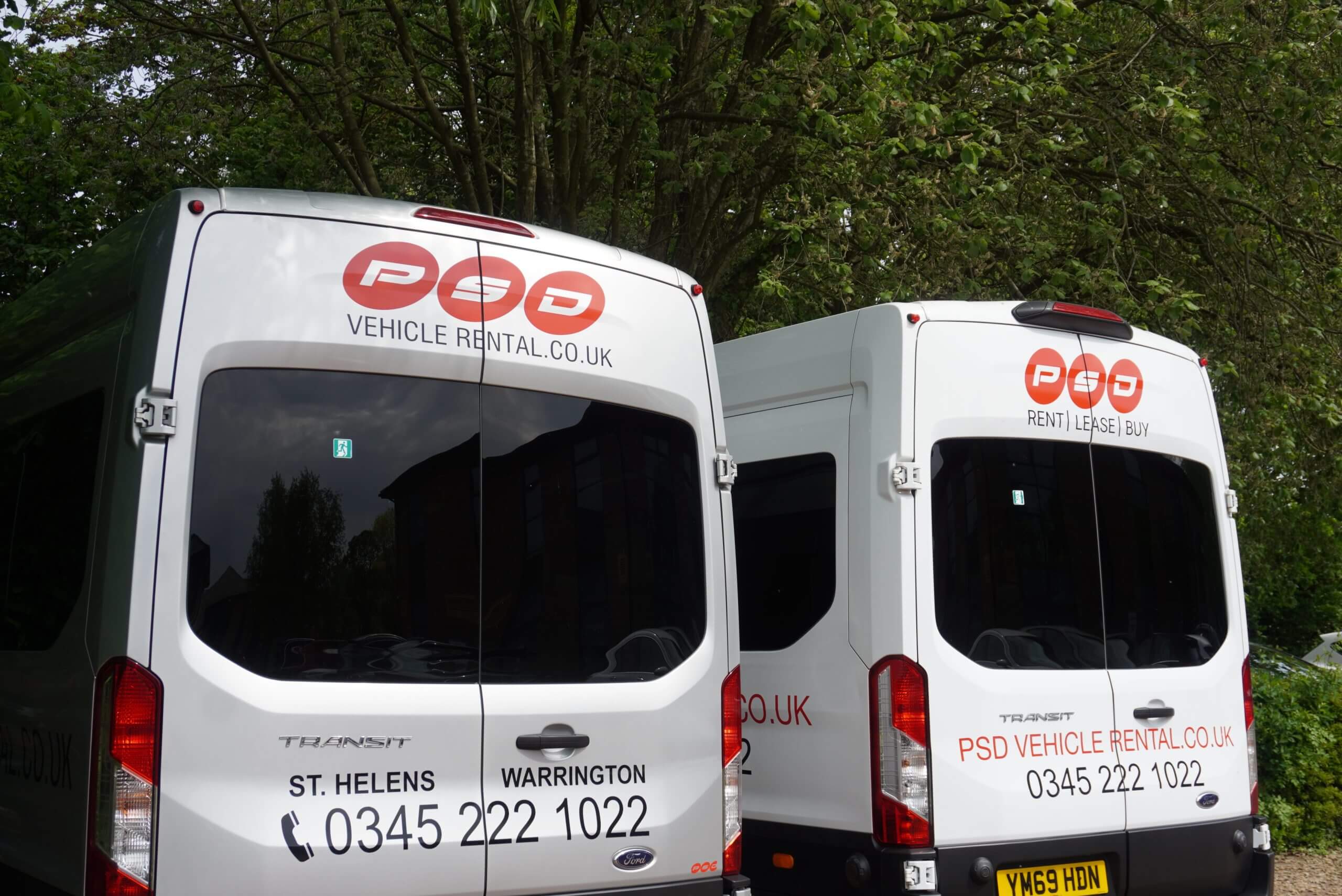
At PSD, we have a fleet of modern minibuses, including 7, 9, 12, and 17-seater vehicles, available for hire.
If you’re hiring on behalf of a company, our business van hire service covers everything from small vans to larger commercial vehicles
For further information or help selecting the perfect hire vehicle for your requirements, be sure to get in touch with our team today!